


Asserting Australia's First Nations Sovereignty into Governance
Stolen Remains
Remains of First Nation Tasmanians have arrived at Launceston
Body
"We bought our old folk home where they belong, they're finally home," delegation member Dave Warrener said.
The bone collectors: a brutal chapter in Australia's past
Body

The remains of hundreds of First Nations people, dug up from sacred ground and once displayed in museums all over the world, are now stored in a Canberra warehouse. When will they be given an appropriate resting place? Some were passed off as victims of frontier violence between tribesmen – but mostly were defending traditional lands on the pastoral frontier – and colonial troops, paramilitary police forces, settler militia and raiding parties. Their bodies were cut up for parts that became sought-after antiquities across Australia and in cultural, medical and educational institutions globally.
Tasmania's Black War: a tragic case of lest we remember?
Body
Nowhere was resistance to white colonisers greater than from Tasmanian Aborigines, but within a generation only a few had survived the Black War.
Taking a look at the war waged against First Nations Peoples
Body
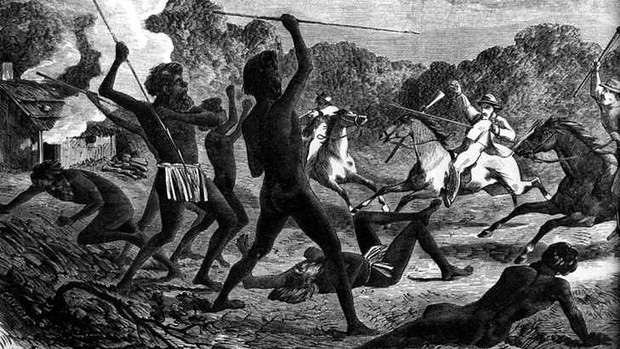
It is now 33 years since the Australian War Memorial (AWM) was first asked to consider recognising the "frontier wars". The suggestion came from an historian and consultant to the memorial, none other than Geoffrey Blainey.
Blainey's case is straightforward. It has now been established beyond doubt that armed conflict between black and white occurred across the continent over a long period of time, and was routinely referred to by participants and observers as a "war"; those conflicts were similar to other irregular warfare already commemorated by the memorial; so, the "frontier wars" should be commemorated also.