


 Governments attempting to counter Sovereighty Movement pdf
After 227 years of military occupation by the British, we have reached a highly significant position in our history. The invaders never thought the day would come when Aboriginal Nations and Peoples would be such a powerful force in the Australian political arena.
The first mention of 'Recognition' was in 2007 when Prime Minister John Howard announced that if he was re-elected, he will put a referendum to the Australian people to formally recognise Indigenous Australians in the Constitution. John Howard's statement was made during the same period of government when he opposed the Declaration on the Rights of Indigenous Peoples, opposed a Treaty and following his suspension of the Racial Discrimination Act to introduce of the Northern Territory Intervention.

Ghillar Michael Anderson 18 February 2015 Governments try to counter Sovereignty Movement: Understanding when we are winning! NITV ran a news item on 17/2/15 reporting that the NSW government and the Electoral Office are calling on Aboriginal people to enrol to vote at the next NSW State election. This call, it is said, is influenced by the impact of the Sovereignty Movement. After 227 years of military occupation by the British, we have reached a highly significant position in our history. The invaders never thought the day would come when Aboriginal Nations and Peoples would be such a powerful force in the Australian political arena. No doubt the same appeal to enroll to vote will apply at the Federal election in 2016, or 17 January 2017 at the latest.
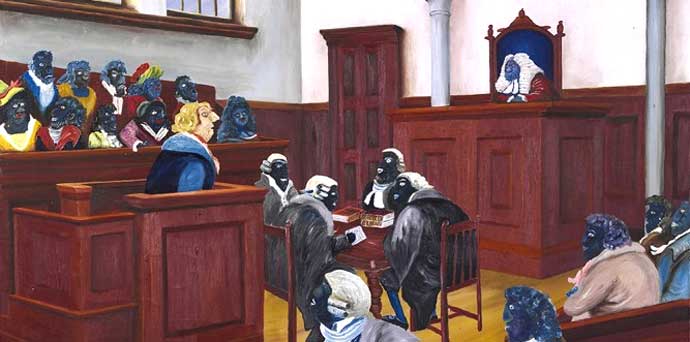
(Image: Gordon Syron's Judgement by his Peers - 1978)
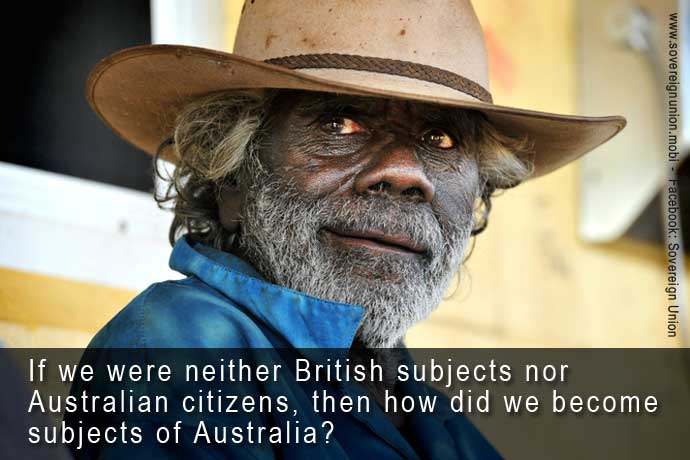
We must understand that, as affirmed by the High Court Mabo (No. 2) judgment, our ancient cultures and Laws have survived British sovereignty and remain the Law of the Land, as they have never been ceded in anyway, shape or form. Aboriginal people are now challenging more than ever the power and authority of the colonial governments. The Commonwealth, State and Territory governments are trying to deceive our people yet again by suggesting that our people are 'Australians' and that they should be part of Australia and vote. I think its time to revisit a speech by Menzies, as the Hansard record of 1 April 1965 makes it clear that Aboriginal people are not Australian citizens. [See below in 'Background']. The only power that keeps government control over us as Peoples are the courts in this country. Courts argue that if English laws were to offer protection to us as people, then the courts rule that we must surely be subject to their laws. But we need to make the point that our people need to understand that we have never been British subjects. As detailed in Quick and Garran's 1901 work on the Australian constitution, if you are not a British subject you are an 'alien' by definition [eg at page 599]. This is a discussion that must be fully examined because like the foreigners in Section 44 of the constitution, if we were neither British subjects nor Australian citizens, then how did we become Australian citizens and subjects of Australia without naturalisation and citizenship certificates being issued?
I revisit the comment I have made previously - have a look at all the Commonwealth legislation affecting our peoples and you will read in the preamble reference to 'the aboriginal race' eg in the Aboriginal and Torres Strait Islander Act 2005 [No. 150, 1989 as amended]:
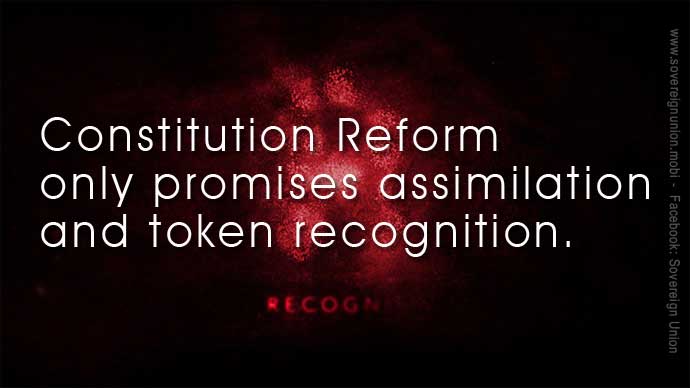
Don't be fooled by the call to join the Electoral Roll. The governments are not our friends at the crunch. They are con artists and tricksters. The Recognise campaign is in the same mould, heavily funded to create spin to lure Aboriginal people into the racist Australian Constitution, which only promises assimilation and token recognition. But the bottom line is - the Commonwealth's funding of the Recognise campaign to include Aboriginal people in the Australian constitution is surely proof enough that we are not already in the Australian constitution and therefore are not citizens and, by definition, are 'aliens'. We must stay true to our own culture and keep our identity intact. Don't sell out for a vote! The governments have taken over our natural resources and claim ownership of our culture. The courts deny the true nature and history of our Nations and Peoples and protect their masters who created them, knowing that it is against international law. 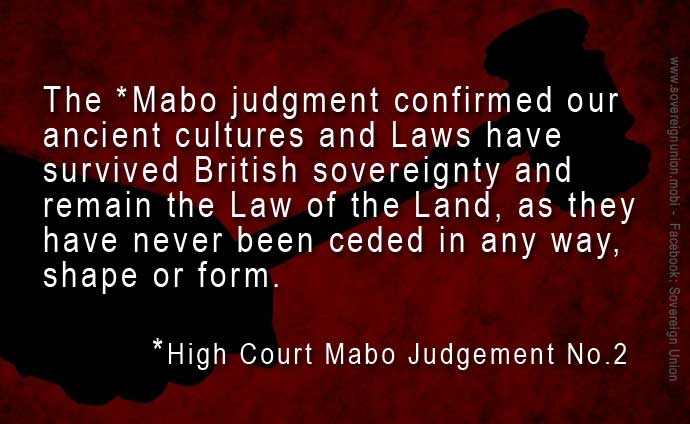
1. http://nationalunitygovernment.org/content/sovereign-treaty-only-consti…;
2. Former PM Robert Menzies on the Race Power:
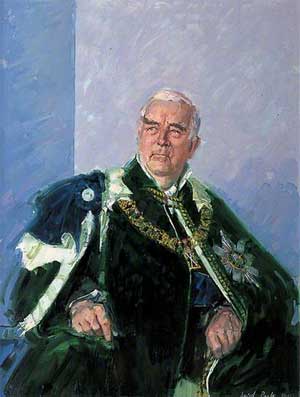
Former Prime Minister
Robert Menzies (1894–1978)
Painted by David Poole, 1971
In the Australian parliamentary debates on the proposed amendment to the two sections of the constitution, Prime Minister Sir Robert Menzies expressed concern about the possible legal outcomes when he said at 533 and 534 Hansard No. 13, Thursday, 1 April 1965 TWENTY-FIFTH PARLIAMENT FIRST SESSION - THIRD PERIOD:
3. Making 'special laws for peoples of the aboriginal race'. The preambular statement to the Aboriginal and Torres Strait Islander Act 2005 (Indigenous Land Corporation) states in Commonwealth legislation that the purpose and functions of the Act establishing the Indigenous Land Corporation (ILC) was:
An Act to establish a Torres Strait Regional Authority, an Indigenous Land Corporation and a corporation to be known as Indigenous Business Australia, and for related purposes WHEREAS the people of Australia voted overwhelmingly to amend the Constitution so that the Parliament of Australia would be able to make special laws for peoples of the aboriginal race; AND WHEREAS the people whose descendants are now known as Aboriginal persons and Torres Strait Islanders were the inhabitants of Australia before European settlement; AND WHEREAS they have been progressively dispossessed of their lands and this dispossession occurred largely without compensation, and successive governments have failed to reach a lasting and equitable agreement with Aboriginal persons and Torres Strait Islanders concerning the use of their lands; AND WHEREAS it is the intention of the people of Australia to make provision for rectification, by such measures as are agreed by the Parliament from time to time, including the measures referred to in this Act, of the consequences of past injustices and to ensure that Aboriginal persons and Torres Strait Islanders receive that full recognition within the Australian nation to which history, their prior rights and interests, and their rich and diverse culture, fully entitle them to aspire; AND WHEREAS it is also the wish of the people of Australia that there be reached with Aboriginal persons and Torres Strait Islanders a real and lasting reconciliation of these matters; AND WHEREAS it is the firm objective of the people of Australia that policies be maintained and developed by the Australian Government that will overcome disadvantages of Aboriginal persons and Torres Strait Islanders to facilitate the enjoyment of their culture; AND WHEREAS it is appropriate to further the aforementioned objective in a manner that is consistent with the aims of self-management and self-sufficiency for Aboriginal persons and Torres Strait Islanders; AND WHEREAS it is also appropriate to establish structures to represent Aboriginal persons and Torres Strait Islanders to ensure maximum participation of Aboriginal persons and Torres Strait Islanders in the formulation and implementation of programs and to provide them with an effective voice within the Australian Government; AND WHEREAS the Parliament seeks to enable Aboriginal persons and Torres Strait Islanders to increase their economic status, promote their social well-being and improve the provision of community services; AND WHEREAS the Australian Government has acted to protect the rights of all of its citizens, and in particular its indigenous peoples, by recognising international standards for the protection of universal human rights and fundamental freedoms through:
- (a) the ratification of the International Convention on the Elimination of All Forms of Racial Discrimination and other standard-setting instruments such as the International Covenants on Economic, Social and Cultural Rights and on Civil and Political Rights; and
- (b) the acceptance of the Universal Declaration of Human Rights:
Add new comment