


Asserting Australia's First Nations Sovereignty into Governance
Gross Abuse

Legalised slavery - another hidden reality in Australia's 'proud' history
Body
Felicity Holt is almost 77 years old. She lives in Queensland and remembers the day she was taken away from her parents in Cherbourg. She was just 16 and hopeful of a future in nursing. 'I had enrolled in nursing at the Cherbourg Hospital because I love looking after people, and they came and took me and sent me to St Joseph's Convent in Dalby to work in the kitchen,' Mrs Holt said.
Wong-goo-tt-oo elder sings about the spiritual and cultural importance of the Burrup rock art
Body
Tim and Wilfred were preparing to return home, filmmaker Ellie Gilbert was able to video Tim Douglas singing again at the Canberra Airport - Also available on Vimeo
Out of the Silence
Body

by Robert Foster and Amanda Nettelbeck,
with extensive footnotes, index and photographs.
...Regardless of all the nice talks, policies and promises in England during the 1830s, South Australia was invaded in 1836. The British government called it settled instead and pursued a new approach to the treatment of Aboriginal people that would hopefully avoid the horrific violence that had been part of earlier Australian settlement. From now on any acts of violence or injustice towards Aborigines would be punished 'with exemplary severity'.
Frontier History Revisited - Colonial Queensland
Body
*/
/*-->*/
Frontier History Revisited - Colonial Queensland and the 'History War' by Robert Ørsted-Jensen, 278 pp, Lux Mundi Publishing, Brisbane, 2011, ISBN 9781466386822, c$27.00.
Videos of the 2011 Remembrance ceremony and March
Body
Location: Canberra Embassy ceremony and ANZAC Day March 2011
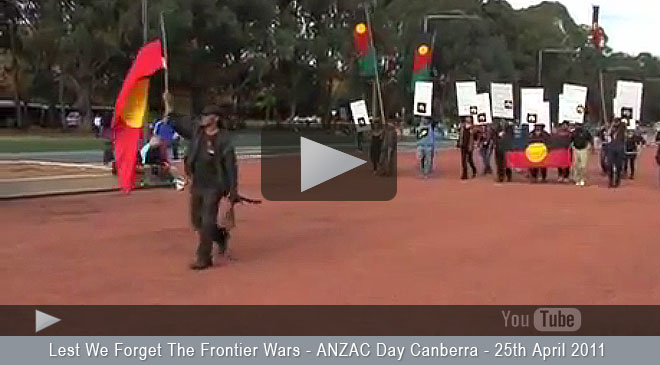
This is a cut of the 2011 ANZAC Day video above - providing footage of the March day only - see footage of the vigil below.
Remains of First Nation Tasmanians have arrived at Launceston
Body
"We bought our old folk home where they belong, they're finally home," delegation member Dave Warrener said.
The Frontier Wars
Body
*/
/*-->*/
The 'Great Silence' of Australian media fails the First Nations people
Body
First Nations people were expressly excluded from voting in federal elections until 1962, they did not have full citizenship rights and were not counted in censuses until 1967 and were classed as "flora and fauna". Conversely, between 1949 and 1973 British citizens could enter Australia without a visa, access welfare and had the right to vote. British subjects on the electoral roll before a change in legislation in 1984 still have the right to vote without being a citizen.
Wotton family launches class action over 2004 Palm Island death in custody
Body

Agnes Wotton

Lex Wotton

Cecily Wotton
Allyson Horn 24 June 2014