


Asserting Australia's First Nations Sovereignty into Governance
Media Releases
Governance and Doublespeak
Body
Professor Ghillar, Michael Anderson, Convenor of the Sovereign Union, last surviving member of the founding four of the Aboriginal Embassy and Head of State of the Euahlayi Peoples Republic provides an insight into the current interplay of doublespeak in governance….
The definition of doublespeak is language used to deceive usually through concealment or misrepresentation of truth. It is language that intentionally obscures, distorts, or reverses the meaning of words.
Concealing colonial strings of control
Body
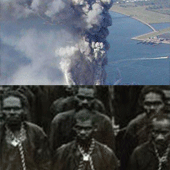
On this anniversary of 9/11 it is a good opportunity to compare spin and denial. The events of 9/11 are still being analysed, but Dr Judy Woods’ collection of photographs reveal far more than the impact of two planes flying into the Twin Towers.
Australia will never accede to any demands for a truth-telling commission relating to its historical processes of colonisation, because of the consequences that will have to be faced by England and Australia alike for their wrongdoings.
John Howard recognised continuing Aboriginal sovereignty in his Ten Point Plan for limiting Native Title
Body

Former PM, John Howard
With the passage of time it is now painfully obvious that former Prime Minister, John Howard, fully realised that Aboriginal peoples maintain a very powerful position in Australia, so much so, that by amending the Native Title Act in 1998 he demonstrated the inherent power of Aboriginal peoples, which stems from our continuing sovereignty.
Having now reviewed his Ten Point Plan it is important for us, as First Nations Peoples, to revisit John Howard’s amendments and what they meant.
Howard’s Ten Point Plan promised ‘bucket loads’ of extinguishment of Native Title after the Wik decision, in which the High Court found that Native Title continued to exist on pastoral leases in Queensland. This sent the Howard government into a fervent need to create ‘certainty’ for the non-Aboriginal landholders, driven by the fear in existing landholders of our continuing connection to Country.

First Nations prepare legal way forward for sovereign rights
Body

Ghillar, Michael Anderson, reporting that the Sovereign Union Gathering of Nations held at the Yarramundi Cultural Centre, Canberra, from 23 to 25 November 2018 successfully dealt with key issues facing First Nations.
Those attending came from across the continent and welcomed the opportunity to raise the problems they face and to understand ways of dealing with them, while joining the dots to understand the bigger picture of forced assimilation through fraud and deceit.
Call for information on NSW Land Council election irregularities
Body
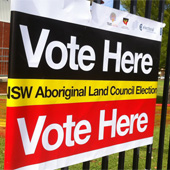
Reports of deceased names used and Aboriginal people have been turned away from polling places in various places because their names are no longer on the membership roll despite having voted in the 2011 NSW Aboriginal Land Council election. Potential voters were turned away. We need to establish a register of how many people were actually turned away on the voting day and other irregularities. In this regard people can contact the Sovereign Union Facebook message system and tell your story.
Scullion commits to saving South Australian homelands BUT...
Body

Anangu Pitjantjatjara Yankunytjatjara (APY) Peoples have the potential to operate as an independent sovereign Nation state by virtue of the fact that they have an entry permit system (equivalent to a visa) and they have veto powers in respect to applicants seeking to come into their country. However, when the veil of power is lifted from their governance, it is evident that the Lawmen and women of the APY Executive Board do not understand the extent of their unlimited powers and most of their lands have been negotiated away through Indigenous Land Use agreements.
1965 Freedom Ride re-enactment back on track
Body

Ghillar Michael Anderson responds to a confrontation with those organising 1965 Freedom Ride re-enactment, in particular Rachel Perkins who took offence at his comments in a recent media release.
Having now spoken with all the parties, which was not done in the first instance, Michael Anderson corrects some matters in his previous statement, including that Noel Pearson will be travelling on the 2015 Re-enactment.
1965 Freedom Ride re-enactment going off track
Body

February 2015 is the 50th anniversary of Charles Perkins' and Sydney University's Freedom Ride from Wellington, Walgett, Moree, Gulargambone, Boggabilla, Bowraville and Kempsey etc, but having learnt of Rachel Perkins' proposal to travel with Noel Pearson to commemorate this historic occasion, this commemorative re-enactment of the original Freedom Ride will not be celebrated for what the original Freedom ride stood for.
Anderson responds to Malezer's condemnatory 'GLOBAL ALERT'
Body
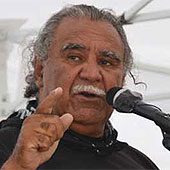
Ghillar Nichael Anderson seems to have put Les Malezer's nose well out of joint when he showed his ignorance of the historical factors behind the NAC's original participation in 1981. 'Clearly his attempt to discredit me at the international level through his 'Global Alert' is something I would expect of the government and not a co-chair of an Aboriginal body'. Anderson said. '... it shows the political divide between 'National Congress' and the grassroots sovereignty movement'.