Land Sea and Water

First Nations are Water Owners, Not Stakeholders

Body
Water is life

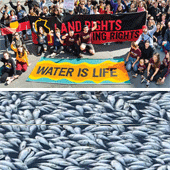
Ghillar, Michael Anderson, asserts that First Nations are owners of water, not just stakeholders and promotes the callout for the 'Water is Life National Gathering' in Canberra on 12 and 13 February 2019. After the massive fish kills in Menindee Lake he demonstrates with a 2019 image from Google Earth that there is still plenty of water just southwest of Menindee Lake, in the Tandou cotton farm, which had a bumper crop this year and has just planted another. This is after selling its water licence for $78 million for an environmental water buyback in 2017 and not being charged for its final year of water allocation.
MDBA Water management: "Don't leave Dracula in charge of the Blood bank"

Body
Northern Basin Aboriginal Nations (NBAN) Media Release

Northern Basin Aboriginal Nations (NBAN) - MEDIA RELEASE - The disaster on the river system is NOT caused just by the drought but is also a culmination of man-made mismanagement; corruption at the highest levels; and major development without scientific evidence-based planning in the formative years of the MDBA. At an emergency meeting of the NBAN Board of Directors in Moree on the 11, 12 & 13 January 2019, it was determined that an urgent intervention is required.

High Court challenge to $1.3b native title deal

Body
Colin Barnett, the WA Premier reduced the sacred sites registered in his state by 1,300

Action has begun in the High Court to try to stop a native title deal that could be worth $1.3 billion to the Noongar people of the south west of Western Australia.

The challenge is by other Noongar native title claimants who say they did not agree to the deal with the WA government to relinquish native title rights in return for a $1.3 billion compensation package.

The package would include land and funds for a trust to be managed by Indigenous and non-Indigenous leaders.

Documentary film explores significance of Aboriginal entrepreneurship in Victoria during colonial times

Body
Aborigional entrepreneurial opportunity

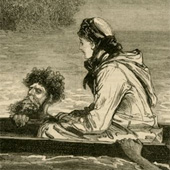
Two film makers are exploring the vital role Aboriginal transport played in the Victorian economy. Seeing the Land from an Aboriginal Canoe is a documentary film which explores the significant contribution of the stringybark canoe. The filmmakers were inspired by historian, Dr David 'Fred' Cahir, who specialises in forgotten Indigenous history. They were particularly drawn to his research into the stringybark canoe and its role in Victoria's waterways. In the film, Dr Cahir said most Aboriginal history was about violence and massacres, and not the Aboriginal contribution.

First shipment of nuclear waste on its way, as we speak

Body

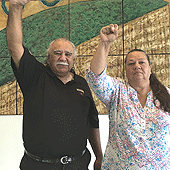
The first shipment of Australia's nuclear waste to be returned from re-processing in France has now left a French port, and will arrive on our shores by the end of the year. The return of the 25 tonnes of nuclear waste is putting renewed pressure on the Federal Government to find a location for a permanent waste dump. The shipment began its journey just a day after senior Aboriginal women gathered in Adelaide to mark their fight against a proposed dump in South Australia in the 1990s. The women say they will fight against any new move to put the waste on their land.

First Nations communities are losing out in the development of northern Australia

Body

Tony Abbott tells us that his northern development obsession "will benefit every single Australian" but a Research Fellow in Anthropology at Australian National University writes that while this may be good news to developers, it makes many First Nations people in the region very anxious.
Today it's much harder for First Nations people to support development, as many are now able to see clearly how the costs and benefits associated with large-scale development in the region are distributed unequally.

First Nations fire methods could slash global emissions: UN report

Body
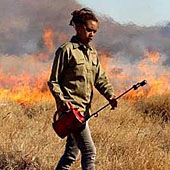
Indigenous fire methods could slash global emissions says UN

Ancient Indigenous Australian bush-burning could be used around the world to radically cut greenhouse gas emissions, according to United Nations research, which also challenges Prime Minister Tony Abbott's refusal to embrace the purchase of international carbon credits. Abbott has previously said buying overseas offsets sends money "offshore into dodgy carbon farms in Equatorial Guinea and Kazakhstan".

The government this month delayed considering the measure until 2017 or later, saying it would rather make cuts domestically.

Giant Lake Mungo was 20 per cent bigger than we thought, say researchers

Body
Lake Mungo

Researchers established that Lake Mungo's high water mark was five metres higher than previously realised, and results of an international study has revealed that the iconic lake situated 90 kilometres north-east of Mildura, was actually a mega-lake, almost 20 per cent bigger than thought before. "Traces of people's activities are actually embedded in sediment, so that tells us that people were relying on watercraft to get around to exploit what was on the island in terms of animals to hunt," said La Trobe University archaeologist Nicola Stern.