Western Australia

High Court challenge to $1.3b native title deal

Body
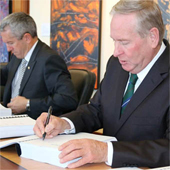
Colin Barnett, the WA Premier reduced the sacred sites registered in his state by 1,300

Action has begun in the High Court to try to stop a native title deal that could be worth $1.3 billion to the Noongar people of the south west of Western Australia.

The challenge is by other Noongar native title claimants who say they did not agree to the deal with the WA government to relinquish native title rights in return for a $1.3 billion compensation package.

The package would include land and funds for a trust to be managed by Indigenous and non-Indigenous leaders.

Police move in on protester: Native title cannot stop fracking

Body
Micklo Corpus holds the move-on notice

An Aboriginal traditional owner from Broome has been moved on by police for blocking Buru Energy vehicles from accessing a gas fracking site. Last year 96 per cent of his people voted against the fracking program. John Howard recognised continuing First Nations sovereignty in his Ten Point Plan for limiting Native Title he introduced after the Wik decision, promising 'bucket loads of extinguishment' and that what we've got. Companies can destroy country and even though First Nations people are sovereign, they can't do anything about it, other than protesting.

Human life in WA's Mid West existed 30,000 years ago, archaeologists say

Body

The first proof that humans lived in Western Australia's Mid West at the same time as humans in the Pilbara and South West regions has been found in a cave 50 kilometres north-west of Cue.
Previously, archaeologists had no established evidence that humans occupied the Mid West region more than 10,000 years ago. But charcoal associated with stone artefacts excavated in the Yalibirri Mindi rock shelter in the Weld Range have been shown to belong to ancestors of the Wajarri native title claimants living 30,000 years ago.

Massacres Memorial launched in WA's South East

Body
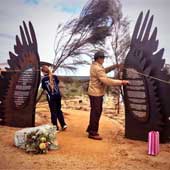
The Kukenarup Massacre Memorial

Kokenarup massacre: In 1880, a family group of approximately 36 First Nations people were massacred about 15 kilometres from the Ravensthorpe in Western Australia's south west region. One account states that John Dunn, a farm worker, attacked and raped a young Nyoongar girl and in accordance with the Nyoongar lore of that region he was subsequently killed by Yandawulla Dibbs and a group of local Nyoongar men. Dunn's overseer sent out word of the killing, and returned with a large group of armed settlers who rounded up and slaughtered around 36 Nyoongar men, women and children.

Why First Nations people need autonomy over their food supply

Body

Going without food, or going without nutritious food, has heavy consequences for Indigenous people, as we learnt on a recent research trip to the West Kimberley. Indigenous Australians are already twice as likely to have a disability or chronic illness as non-Indigenous Australians; poor nutrition compounds these problems, leading to further illness and secondary impairments.Aboriginal people consistently reported alleviating food insecurity by going crabbing or fishing on traditional lands. Though this accounted for a small portion of total dietary intake.

Barnett's War on First Nations people - Aboriginal Health programs slashed by half

Body

The Aboriginal Health Council of Western Australia has described being hit by a double whammy after finding out about a 50 per cent state budget cut to Indigenous programs. It's all to do with ratings and unless the services are rated as 'very good' they lose their funding. Dr Hames said the Health Department believed a lot of programs listed as good still provided a quality service, and funding would be found somewhere.

Fighting domestic violence shouldn't mean revoking Aboriginal rights

Body

Rosie Batty was right to criticise the federal government's allocation of a mere $16 million over three years to family violence in last week's budget. By comparison, more than a billion dollars was set aside for national security measures, an issue that is arguably costing fewer Australian lives at the present time. But when it comes to introducing oppressive legislation on the basis of race, state and federal governments suddenly seem to become incredibly concerned about violence against women - Celeste Liddle writes

Grandmothers Against Removals will hold a week long 'National Gathering' at Matargarup, Perth WA

Body
Grandmothers Against Removals - Perth 2015

'Grandmothers Against Removals' (GMAR) is leading a conference at Matagarup, the Perth Tent Embassy from May 24 - May 30, to strategise for the future and to march on May 26. The gathering will hold a National Protest on 'Sorry Day', May 26th, as this date marks 18 years since the release, of the 'Bringing Them Home' report. This report detailed the horrors of the Stolen Generations in the 20th Century, and called for urgent action to stop the continued removal of Aboriginal children from their families by 'child protection' agencies.

Remote communities management riddled with neglect and blundering

Body

The Western Australian Department of Housing has not been properly monitoring remote communities services and have not applied their 'apparent' eligibility criteria since 2008. Now, all of a sudden, when Barnett wants to close communities down to save money and make the land available for mining and other interests, his department is saying there must be at least 50 members per Homeland community and and that 24 Homeland communities don't meet the criteria. Throwing in the report that surfaced at the same time that some communities have Uranium contamination demonstrates appalling neglect.

First Nation communities should not be closed: International academics weigh in

Body

For over two centuries, the Aboriginal and Torres Strait Islander people of Australia have had to endure brutal agression against their societies. Every year on Australia Day, Australians celebrate the arrival of the First British Fleet, on 26 January 1788, on the coast of Eora Country. But today, the first peoples of Australia still call it « Invasion Day ». This difference in perceptions bears witness to the political and cultural gap which separates Aboriginal people from other Australians.